
Stardew Valley Preserves Jar vs Keg: Recipes and Value Breakpoints
Compare Preserves Jar and Keg recipes, derive fruit and vegetable price breakpoints, and separate sale value from processing time.
Research and calculation note: Checked November 8, 2026. AI-assisted reference research with independently recomputed breakpoints and example values. Scope: unmodded Stardew Valley 1.6 mechanics. These are sale-value calculations, not observed profit from our own save.
Quick answer
For ordinary fruit and vegetables, compare a Preserves Jar with a Keg using the crop's base price, then consider processing time and the machines you already own. The unrounded reference formulas cross at 50g base fruit and 200g base vegetables: lower base prices favor the Jar, higher ones favor the Keg. Check displayed whole-gold prices for near-ties. Special recipes need a separate comparison. Jar rules, Keg rules.
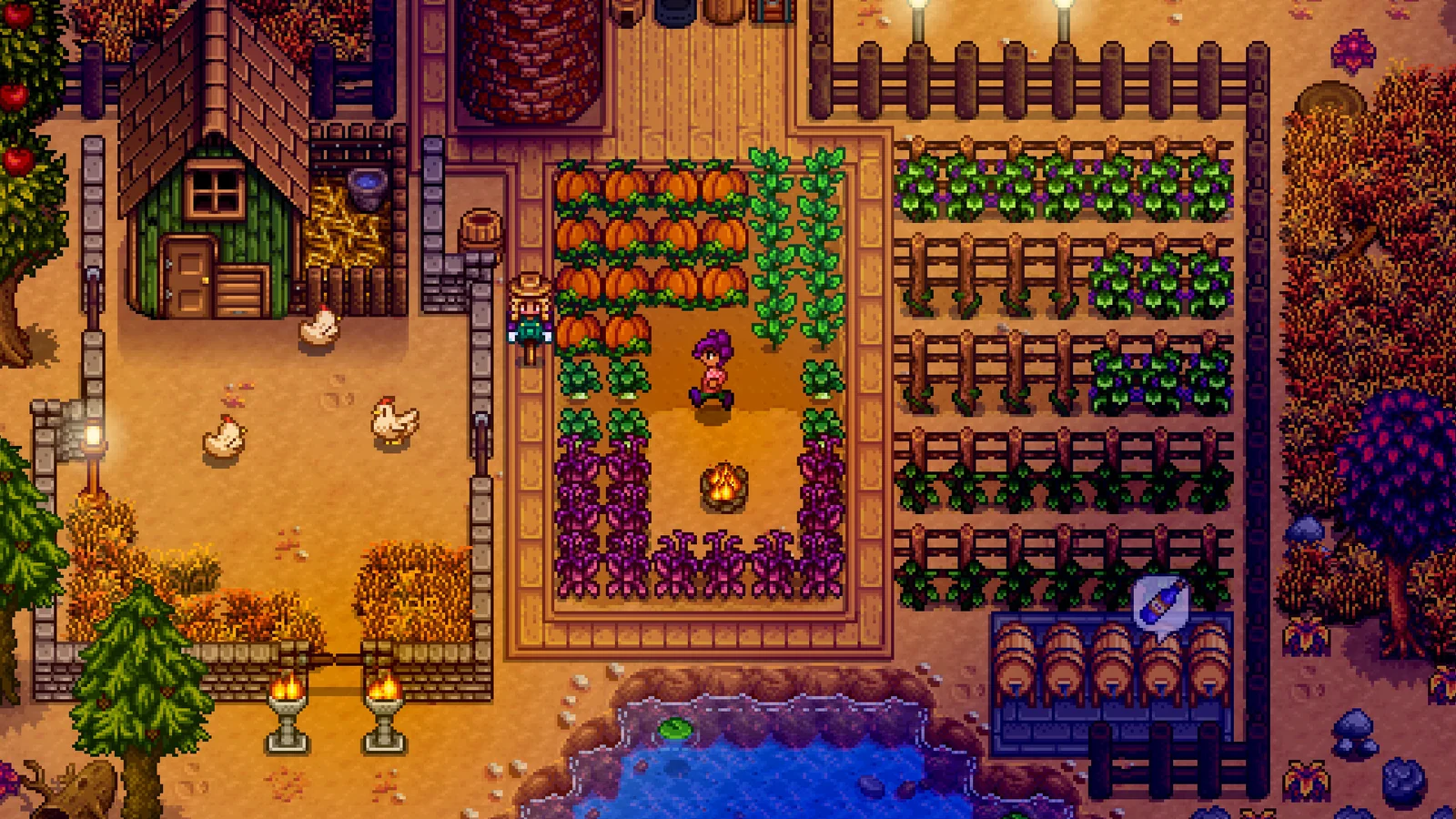
Cover credit: © ConcernedApe. Publisher Steam screenshot gallery. Farm artwork provides processing context; it is not a side-by-side machine test.
Recipes and progression: what each machine costs
The Preserves Jar recipe unlocks at Farming level 4 and uses 50 Wood, 40 Stone and 8 Coal. The Keg recipe unlocks at Farming level 8 and uses 30 Wood, 1 Copper Bar, 1 Iron Bar and 1 Oak Resin. Those are construction costs, not ingredients consumed for every ordinary fruit or vegetable batch.
If you already have a Jar, its available capacity matters even when a future Keg would return more per crop. Keep “what should I load today?” separate from “which machine should I build next?” The first decision can be made without assigning the same purchase or material cost repeatedly to an existing machine.
Derive the fruit breakpoint
Let B be the fruit's normal-quality base price, without Tiller. The cited formulas are 2B + 50 for Jelly and 3B for unaged Wine.
- Set the outputs equal: 2B + 50 = 3B.
- Subtract 2B from both sides: B = 50g.
- At a hypothetical 30g base price: Jelly 110g, Wine 90g.
- At 50g: both 150g.
- At 100g: Jelly 250g, Wine 300g.
The breakpoint compares sale value per input fruit. It does not say the machines finish at the same time or require equal construction effort.
Derive the vegetable breakpoint
For ordinary eligible vegetables, compare Pickles at 2B + 50 with Juice at 2.25B.
- Set them equal: 2B + 50 = 2.25B.
- Subtract 2B: 50 = 0.25B, so B = 200g.
- At a hypothetical 100g base price: Pickles 250g, Juice 225g.
- At 200g: both 450g.
- At 300g: Pickles 650g, Juice 675g.
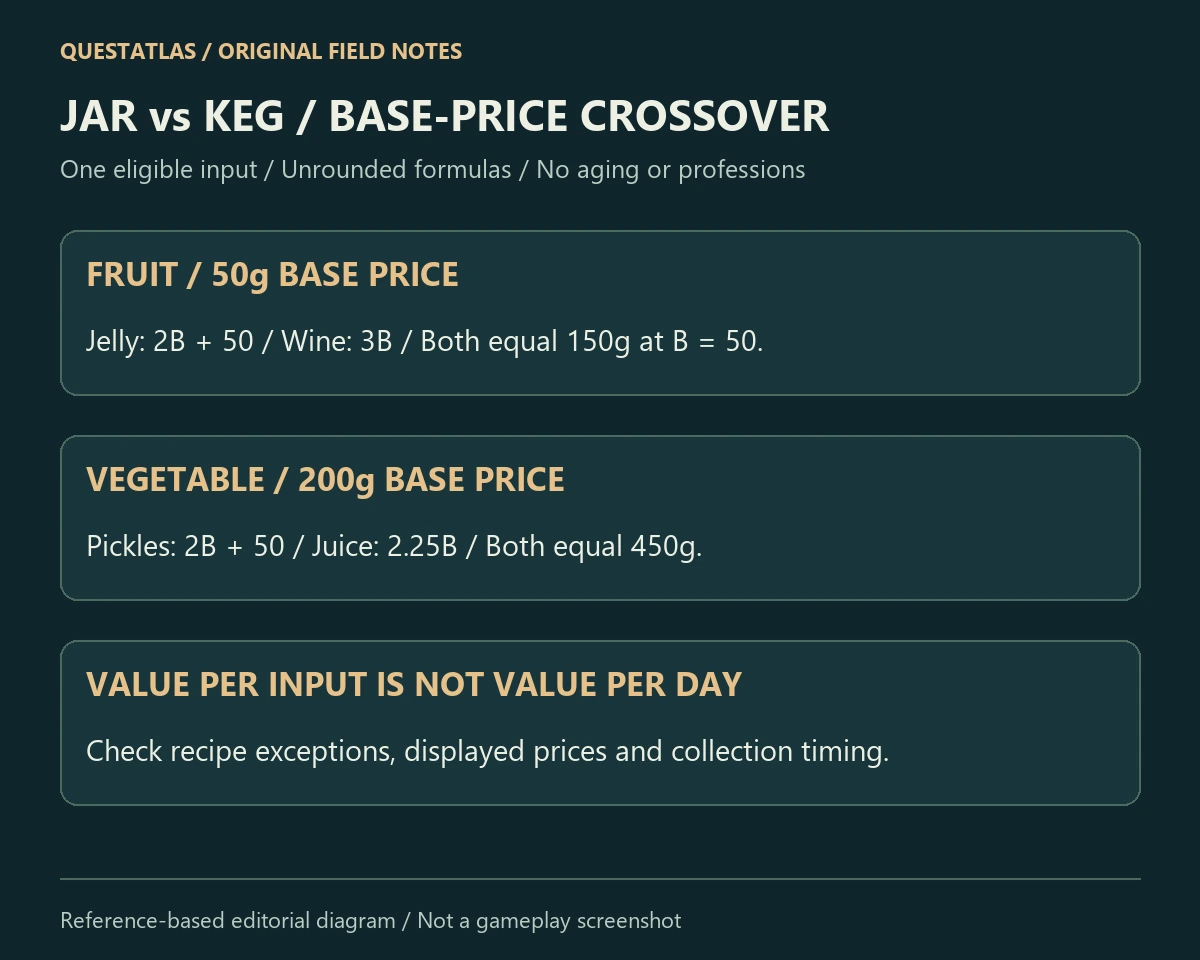
Independent calculation: The algebra and illustrative values were recomputed from the cited formulas. The examples deliberately use simple base prices rather than claim that a named crop always has that sale price.
Do not confuse the base price with the raw stack you give up
Input quality does not turn ordinary Jelly, Pickles or fresh Keg output into a higher-quality product. A gold or iridium crop can nevertheless sell for more raw, changing the opportunity cost. Use the actual raw-stack price when deciding whether processing is worthwhile, while using the base-price recipe rules to establish the output.
Our artisan batch calculator keeps those two inputs separate. For one hypothetical 100g-base fruit, enter a one-item batch and compare 250g output for the Jar with 300g for the Keg. Enter your own raw sell value and any costs you want to recover.
Timing and special recipes can change the practical choice
The reference lists 4,000 processing minutes for ordinary Jelly/Pickles, 6,000 for Juice and 10,000 for Wine. Completion depends on when you load and collect; a larger eventual output is not automatically more gold by the time you need cash.
Do not apply the ordinary fruit/vegetable equations to Keg exceptions such as Hops, Wheat, Coffee Beans or Tea Leaves. Roe products are another separate Jar case. Read the actual product recipe first.
For Ancient Fruit specifically, the Wine versus Dehydrator guide compares equal five-fruit inputs. For five-item drying restrictions, use the Dehydrator recipe guide.
Budget construction before scaling the higher-value option
For twenty newly crafted Kegs, the recipe totals 600 Wood, 20 Copper Bars, 20 Iron Bars and 20 Oak Resin. That excludes the Tappers used to collect the resin. The Oak Resin and Tapper budget adds that second equipment layer, compares collection rounds and explains when existing Tappers should be removed from the new-cost calculation. This is construction arithmetic, separate from the price breakpoints above. Keg recipe.
Sources and limits
- Preserves Jar: construction, products and input-quality rules
- Keg: construction, ordinary products and exceptions
Artisan, cask aging, active collection time, crop supply and available machine space belong in the final decision. We have not simulated a whole farm or measured a daily-income optimum. Send a correction with the crop, quality, professions and build if your values differ.