
Stardew Valley Fish Smoker: Recipe, Jelly Ingredients and Profit Check
Get the Fish Smoker recipe, gather all three jellies, and calculate when smoking a fish is worthwhile after the cost of Coal.
Research note: Checked November 8, 2026 against the references below. This is a source-researched guide, not an independently playtested walkthrough. Scope: 1.6 mechanics, unmodded gameplay.
Quick answer
Buy the Fish Smoker recipe for 10,000g at Willy's Fish Shop. Craft it with 10 Hardwood, 1 Sea Jelly, 1 River Jelly and 1 Cave Jelly. Each smoking cycle uses 1 fish and 1 Coal, takes 50 in-game minutes, and preserves the fish's quality. Fish Smoker reference.
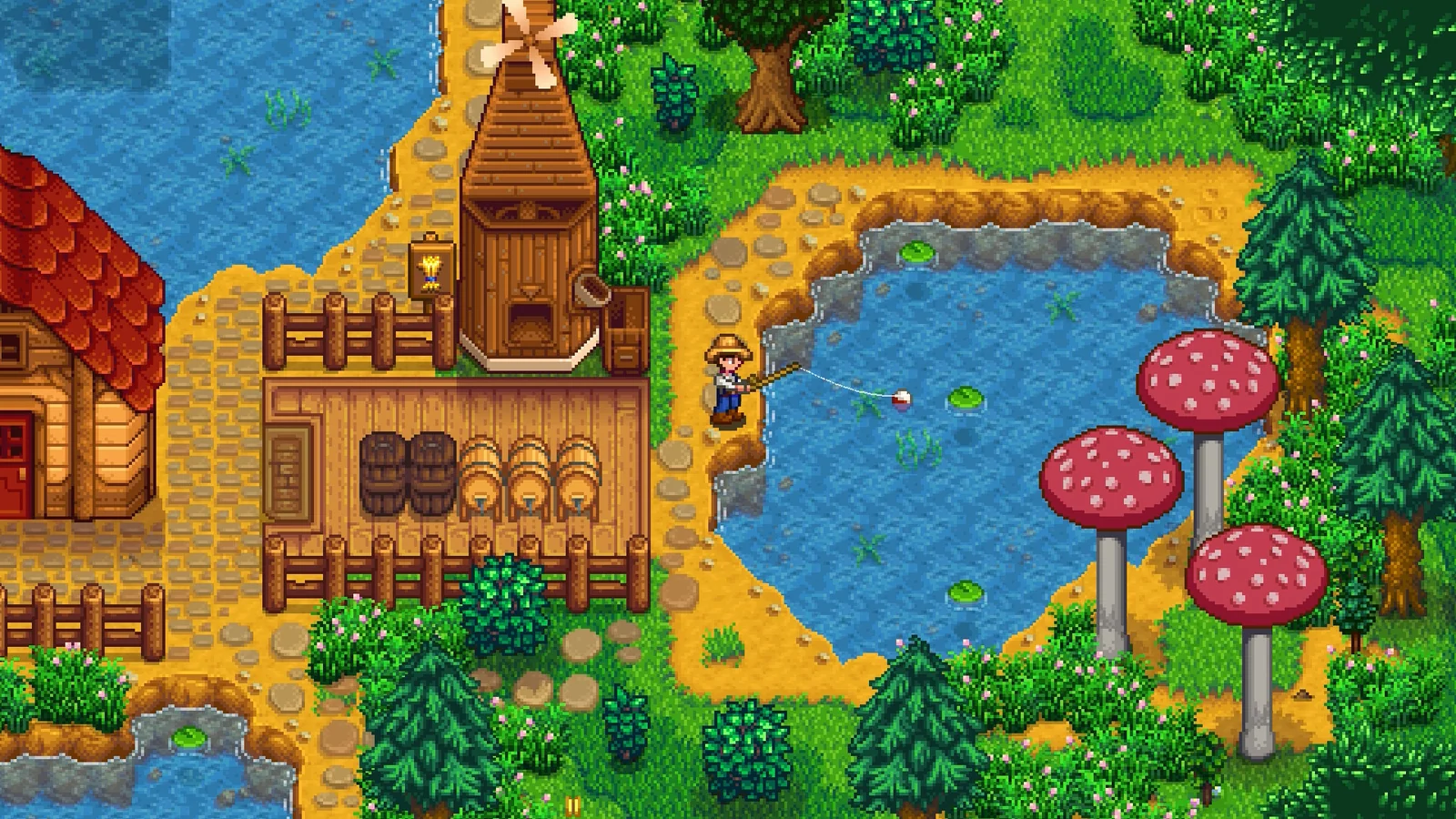
Cover credit: © ConcernedApe, official Stardew Valley Steam screenshot showing a farm pond. This is general fishing context; it does not show a Fish Smoker or identify a jelly-catching spot.
Check the recipe and the three separate jellies
Treat Sea Jelly, River Jelly and Cave Jelly as three named inputs. Having several of one type does not satisfy the other two slots. Before gathering more, compare the exact recipe with the items already stored at your farm.
Riverland Farm starts with a Fish Smoker in the referenced 1.6 mechanics. If your save already contains one, a recipe purchase is needed for crafting more machines, not for operating the one you own. Machine acquisition.
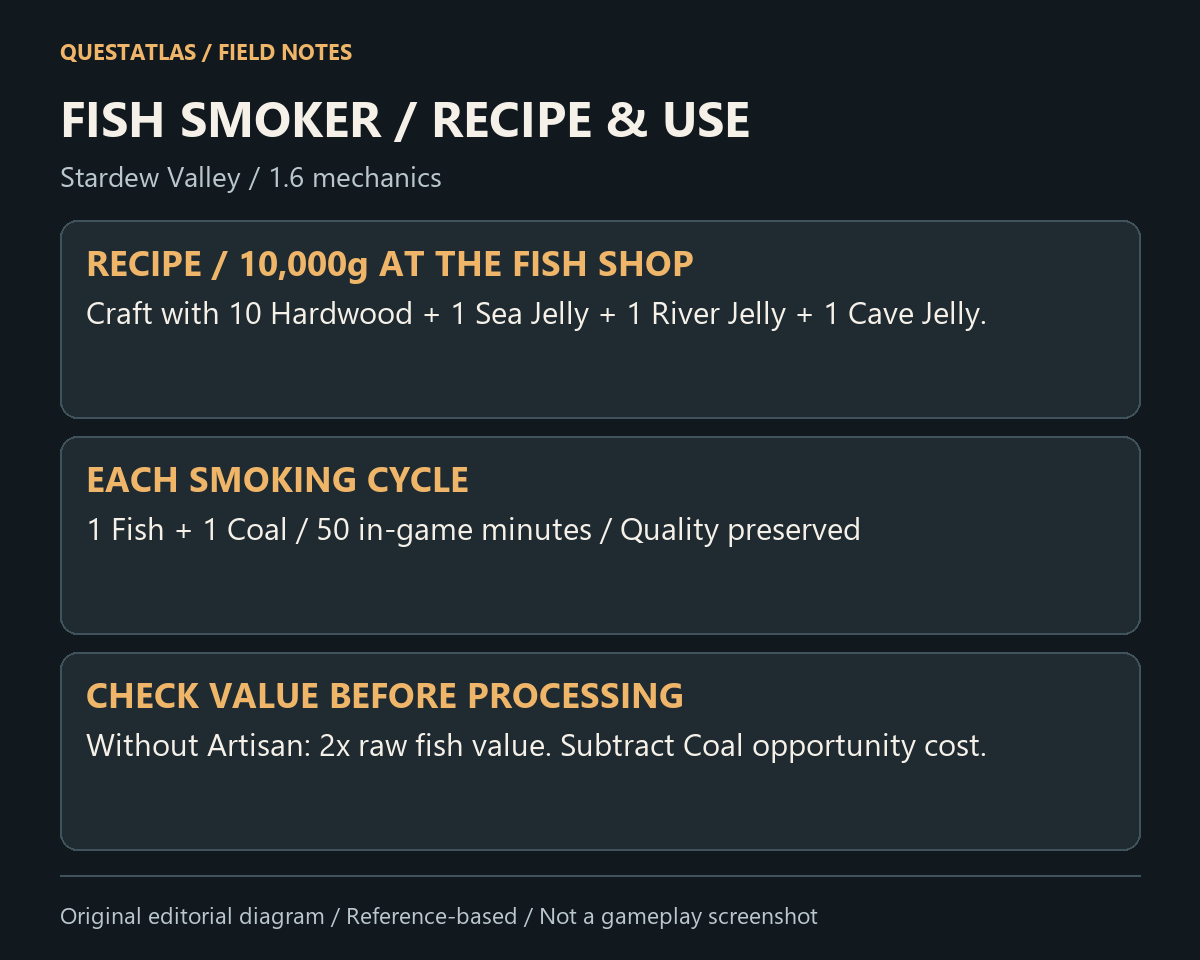
Diagram: Original QuestAtlas recipe and operation checklist, not an image of the in-game crafting screen.
Compare the sale value before spending Coal
The Smoked Fish reference lists a sale value of twice the original fish's price, or 2.8 times with Artisan, while the applicable fishing professions and fish quality also matter. Smoked Fish is an artisan product: it can be sold to Pierre, but not to Willy. Smoked Fish pricing and sale rules.
For a simple comparison without Artisan, let a fish's raw selling value be P and the Coal's replacement cost be C. Smoking adds P minus C to what you could have received by selling the fish raw. This is an editorial opportunity-cost calculation, not a promise that Coal is free because you mined it yourself.
For example, a hypothetical fish worth 200g becomes worth 400g before Coal and the machine's purchase costs. If you value the Coal at 150g, the incremental gain is 50g. Those are illustrative inputs; check your actual fish and Coal source before making a batch decision.
Keep collection and quest fish separate
The machine accepts Legendary Fish according to the reference. That makes it useful to sort protected catches into a separate chest before loading a smoking queue. A higher sale value is not a reason to consume a specimen you wanted to keep.
A practical first-batch routine
Start with one surplus fish and one Coal, collect the result, and compare its displayed sale value with your expected number. Only then decide whether more machines fit your fishing schedule. A fifty-minute processing cycle is in-game time, not fifty real-world minutes.
For a different batch-processing option, compare the Dehydrator's five-item rule.
Use an opportunity-cost check for your own catch
The artisan batch profit calculator works with a one-fish batch as well as a five-fruit recipe. Set input items per batch to 1, enter the raw fish's actual sale value, the smoked product's sale value and the Coal value you want to charge to that batch. Use prices that already include your quality and professions.
Reproduce this hypothetical comparison to see the fuel threshold clearly:
- A 100g raw item and a 200g output leave 50g more than selling raw if batch fuel costs 50g.
- At 100g fuel cost, the two choices break even before machine costs.
- At 150g fuel cost, processing leaves 50g less than selling raw.
The example is arithmetic with deliberately chosen inputs; it is not a measured sale of a named fish. The calculator's fuel example button loads the loss-making case so you can inspect the result and change one value at a time.
For ten 200g fish, ten 400g outputs and a 150g fuel value per batch, the raw sale is 2,000g and the processing proceeds after fuel are 2,500g. The extra value is 500g across ten batches. A hypothetical 10,000g setup investment needs 200 completed batches at the 50g batch margin, before assigning a cost to labor or machine space.
Original calculation: This website tested the calculator, including fuel losses, incomplete batches and non-positive margins. We did not independently measure these examples in a game save. Setup investment is displayed separately from the sale totals so it is not charged again each time you reuse the machine.
Sources and version notes
Recipe panels in your installed build take priority if a later update or mod changes these values. Send a correction.